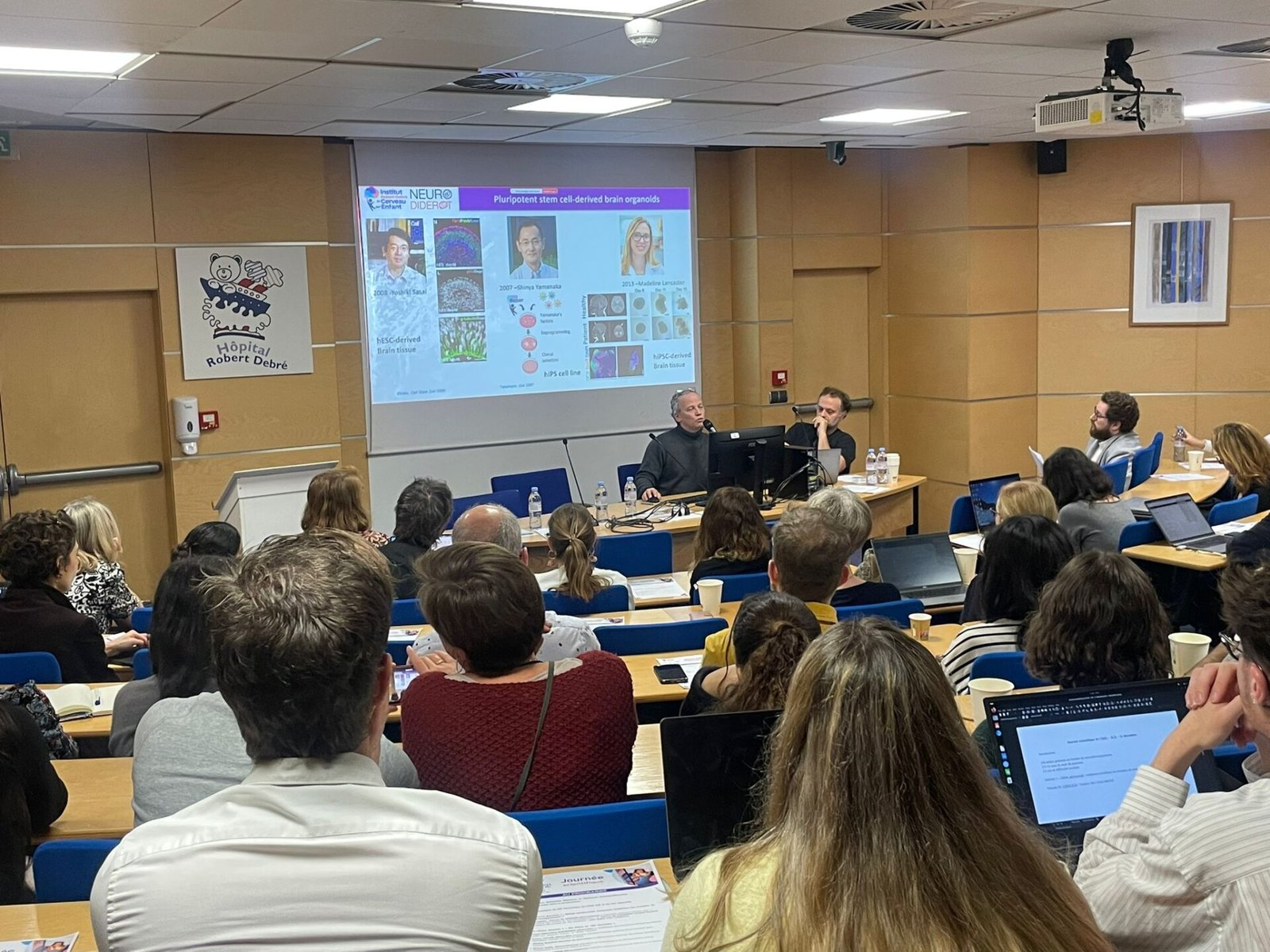
On December 11, 2025, the Robert-Debré du Cerveau de l’Enfant Institute Robert-Debré du Cerveau de l’Enfant ICE) held its Science Day in the Vilmer amphitheater at Robert Debré Hospital, bringing together nearly 80 participants from our institute's scientific and medical communities. This edition provided an opportunity to share and discuss the institute's ongoing research on brain development and neurodevelopmental disorders.
An openness focused on the Institute's priorities
The day was opened by Ghislaine Dehaene, Director of the ICE, who reviewed the Institute's first two years and presented its outlook for 2026. She reiterated the ICE's core ambition: to develop a cross-disciplinary approach to neurodevelopment, combining fundamental research, clinical practice, and innovation to serve children and their families.
Modeling neurodevelopmental disorders: a structuring scientific debate
The first highlight of the morning took the form of a scientific debate devoted to approaches to modeling neurodevelopmental disorders.
Through presentations by Vincent El Ghouzzi from the NeuroDiderot laboratory, head of the NeuroDev team, and Fabrice de Chaumont from the Human Genetics and Cognitive Functions laboratory led by Thomas Bourgeron at the Pasteur Institute. The discussions highlighted the respective strengths and limitations of organoids and animal models. Far from being opposites, the debate emphasized the complementary nature of these approaches, which are essential for better understanding the biological mechanisms of neurodevelopment and accelerating translational advances.
Doctoral students' perspectives: diversity in research at the heart of ICE
The morning continued with two "My Thesis in 180 Seconds" sessions, during which eleven doctoral students presented their work. This dynamic format illustrated the richness and diversity of the research conducted at the institute.
The projects covered a wide range of topics, from cell biology to neuroscience, cognitive science, developmental psychology, brain imaging, and artificial intelligence. These sessions highlighted the vitality of research and the Institute's ability to bring together complementary approaches to neurodevelopmental issues.
Tangible results: the clinical impact of ICE
The end of the morning was devoted to presenting our institute's first concrete results, illustrating the clinical and societal impact of ICE's work:
- Effect of lithium in ASD associated with Phelan-McDermid syndrome presented by Anna Maruani: encouraging preliminary results from a therapeutic trial, opening up prospects for targeted treatments.
- U-REACH presented by Corentin Gosling: an innovative framework aimed at structuring and disseminating scientific data on psychosocial interventions, from autism to ADHD.
- Parental well-being in neurodevelopmental disorders presented by Léa Chawki: a study highlighting the importance of comprehensive care that includes support for families.
A collective dynamic focused on the future
This 2025 Science Day demonstrated the ICE's dynamism and its ability to foster dialogue between fundamental research, clinical research, and the humanities. It is testament to a scientific dynamic that is currently being developed, where established researchers and young talents work together to advance knowledge and promote concrete benefits for children and their families.
The ICE would like to thank all the speakers, participants, and teams involved, and looks forward to seeing the scientific community again in spring 2026 for the next edition.