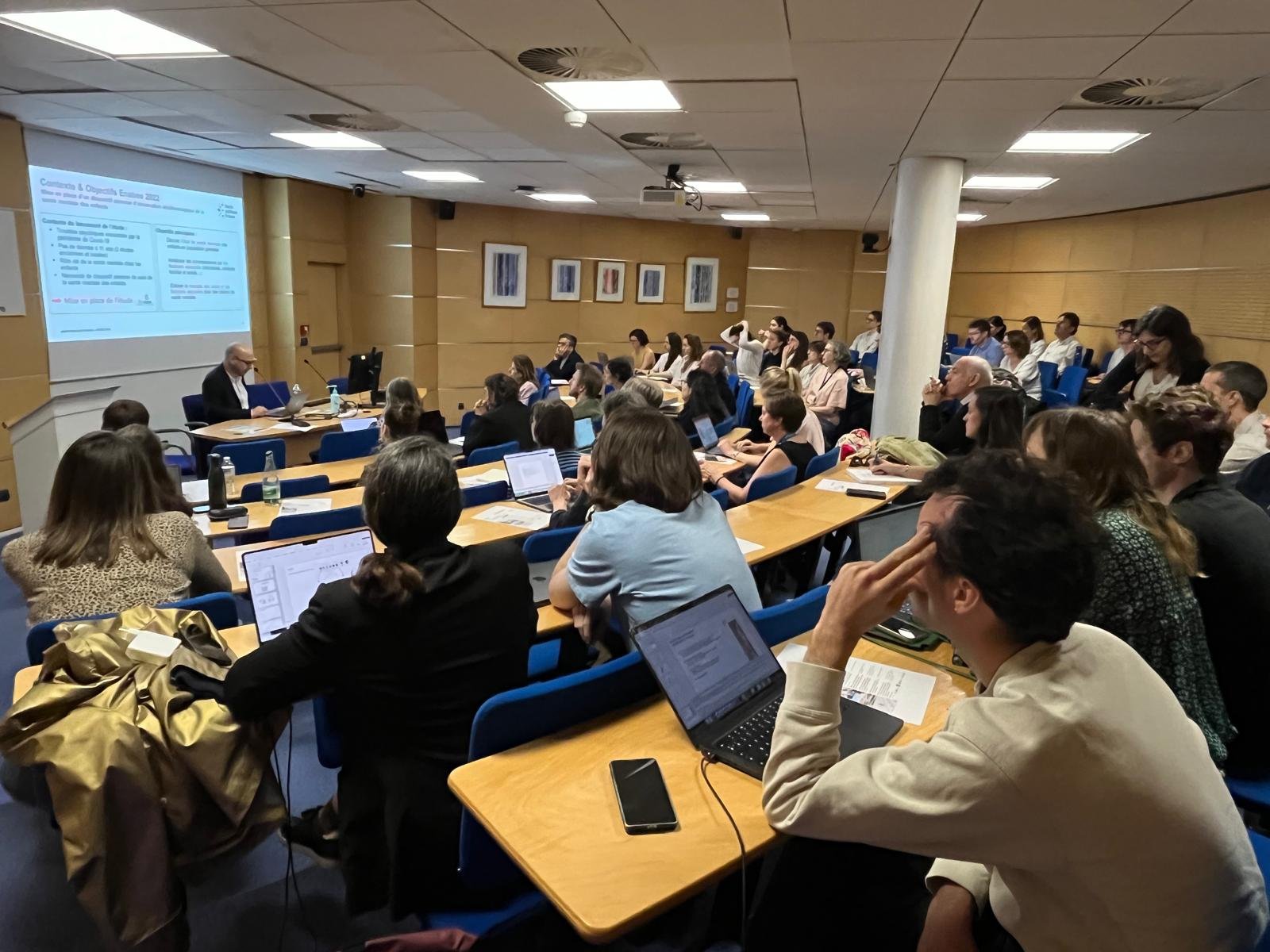
On April 9, 2026, the 4th Scientific Day of the Robert-Debré du Cerveau de l’Enfant Institute Robert-Debré du Cerveau de l’Enfant IHU) was held in the Vilmer Auditorium at Robert-Debré Hospital. More than 80 participants from the Institute’s scientific and medical communities, as well as representatives of children and families, gathered for the event. The conference, moderated by Prof. Richard Delorme, focused on the existing cohorts (health, school, epidemiology, genomics) with which the Institute is associated.
A busy period for the Institute
The day began with an introduction by the director ofIHU, Dr. Ghislaine Dehaene, on the Institute’s latest developments, followed by a presentation by Professor Richard Delorme on the relevance of cohort studies. The groundbreaking ceremony for the building that will houseIHU in 2028 will take place in early June; further details will be announced shortly. Two new members joined the Institute’s executive team this month: a scientific project manager and a communications manager. Finally, two members of the Institute recently secured European funding.
Mental Health and Education: Insights from Large-Scale Data
Yvon Motreff (Santé publique France) presented the results of the ENABEE survey, France’s first national survey on the mental health of children under 11. The survey highlighted the prevalence of probable mental health disorders among 6- to 11-year-olds (13%), as well as challenges in accessing care and links to bullying.
Adrien Pawlik (J-PAL and the Paris School of Economics) then highlighted the value of administrative data for educational research, particularly through the IDEE program. These data provide access to a large volume of comprehensive, standardized data that has already been collected, thereby reducing project costs and facilitating the implementation of longitudinal studies, which are essential for understanding children’s educational trajectories.
This was demonstrated in practice by Alex de Carvalho (Université Paris Cité) through his research conducted in collaboration with the Statistics Department of the French Ministry of National Education (DEPP) on more than 3,000 children in France. Drawing on this type of data, his research highlights the importance of language interactions from a very young age, which are strongly linked to families’ socioeconomic status. He proposes a language assessment tool, TICOALA, designed to identify at an early stage children at risk of language difficulties.
Understanding Child Development Through Cohort Studies: Challenges and Prospects
The second part of the morning provided concrete examples of how cohorts are now used to track children over time and better understand their developmental trajectories. The FILOMENE cohort, presented by Barbara Heude (Center for Research in Epidemiology and Statistics) and Romain Basmaci (AP-HP), is a national cohort project involving 100,000 children followed from pregnancy through adulthood to study the impact of the environment on health and neurodevelopment. At the clinical level, the work of Anna Maruani and Anaël Ayrolles (AP-HP) demonstrates how data from routine care can be structured to reconstruct the pathways of children with neurodevelopmental disorders, while highlighting the challenge of aligning data that remains highly fragmented. The neuroimaging research presented by Jessica Dubois highlights the contribution of multimodal brain imaging (MRI, EEG) to characterizing brain phenotypes and identifying early biomarkers. Finally, the work of Claire Leblond and Mathis Fleury (Institut Pasteur) focused on the genetic contribution to neurodevelopmental disorders, enabling large-scale analyses of genotype-phenotype relationships across large cohorts.
Collecting multidisciplinary longitudinal data to better support children
This scientific conference demonstrated the potential of large-scale cohorts in France. However, despite the wealth of existing data from the fields of health, education, epidemiology, and genetics, the fragmentation of these datasets underscores the need to integrate them, bring different disciplines together, and promote open access to this data in order to fully realize its potential.
The Robert-Debré du Cerveau de l’Enfant Institute Robert-Debré du Cerveau de l’Enfant to this approach through the development of a multidisciplinary longitudinal cohort that integrates clinical, neuroimaging, and biological data. This cohort will enable detailed monitoring of the neurodevelopmental trajectories of children at risk or with a neurodevelopmental disorder, and will allow for better support as they develop. This approach is thus part of the era of precision medicine and education.
IHU would like to thank all the speakers, participants, and teams involved, and looks forward to seeing the scientific and medical community at the next event.
Resources
Results of the ENABEE survey: https://www.santepubliquefrance.fr/studies-and-surveys/enabee-national-study-on-child-well-being/documents/initial-results-of-the-enabee-study-on-the-well-being-and-mental-health-of-children-aged-6-to-11-in-metropolitan-france
To learn more about the IDEE program: https://www.idee-education.fr/
Link to the FILOMENE page on the France Cohortes website: https://francecohortes.org/cohortes/annuaire-des-cohortes/FILOMENE
Link to the study by Mathis Fleury and colleagues: https://www.medrxiv.org/content/10.1101/2025.11.24.25340858v2